As fireworks bang on the Fourth of July
and the Star Spangled Banner plays, we often forget about the meaning
behind the celebration. The wars and battles that protected our
country produced thousands of heroes, eight of whom are traveling
with us. However, with all of our celebrations and festivals, we can
convince ourselves that war is a good thing. While spending time with
our veteran, Walter Fitzmaurice, we have realized just how atrocious
war can be.
Unlike many of the soldiers joined the
military because they were inspired to fight, Walt had the
responsibility of war thrusted upon him. Drafted into the Army Air
Force in 1942 at the age of eighteen, he reluctantly left his home to
face the uncertainty ahead. His call to service was untimely, but his
duty to serve and protect the country he loved far outweighed his
personal desires. Soon after basic training, he was selected for
radio operator training in South Dakota. When asked if he wanted to
learn radio operations, he simply responded, “At that time, I just
wanted to go home.”
Walter and his nine fellow crew members
were eventually stationed at Shipdham Air Base in England, where they
received final training on their plane—the B-24. As a part of the
44th Bomb Group and 68th Squadron, the crew
flew thirty total missions across Europe. Amazingly, all members of
Walt's crew survived, in spite of close encounters with the enemy and
three crash landings. Walter received the French Medal of Merit and
the Distinguished Flying Cross, and was allowed to return to the US
in 1945 to begin his life after war.
The first thing Walter taught us was
that there IS life after war. The men who survived lived the rest of
their lives forever changed because of their time in service. Forced
to mature quickly, Walter and others made incredible sacrifices. But
we must remember to honor who they are, not just what they did.
Walter was an airman who bravely defended his country in its time of
need. However, Walter Fitzmaurice is a husband of 64 years, a father
of eight children, an active Massachusetts citizen, and a man with
stories that should be heard. That is WHO he is.

As we have learned who Walter is today,
he has also taught us about the past. At the American Air Museum, he
showed us all the working parts of a B-24 aircraft. At the Cambridge
American Cemetery, we escorted him past the grave sites of fellow
airmen as he told us his own experiences. On each bus ride, he has
passed on life lessons that have impacted him. But most of all, we
have witnessed how big Walter Fitzmaurice's heart is. He has shown
that loving deeply, even in times of pain, is the best way to display
the love of Christ.
Ramsey-Michele Pruitt, sophomore
Matthew Matney, senior


 As we have learned who Walter is today,
he has also taught us about the past. At the American Air Museum, he
showed us all the working parts of a B-24 aircraft. At the Cambridge
American Cemetery, we escorted him past the grave sites of fellow
airmen as he told us his own experiences. On each bus ride, he has
passed on life lessons that have impacted him. But most of all, we
have witnessed how big Walter Fitzmaurice's heart is. He has shown
that loving deeply, even in times of pain, is the best way to display
the love of Christ.


 This morning, we were able to spend quality time with our veteran at the Imperial War Museums at Duxford. One of the museums that we visited was the American Air Museum. This museum housed many of the planes used throughout American history. Tom was among the first group of 1100 draftees to become medics for the Army Air Corps at the end of January 1942. While in the Medical Branch of the US Army, Tom was the sole man responsible for all medical records, which included 1200 airmen plus ground crews. While he did not fly in the planes, Tom recalls sweating out the arrival of the flight crews returning from missions. He was based at Shipdham Airfield from October 1942 until the end of July 1943. At this specific airfield, B-24 Bombers were flown, one of which was on display at the American Air Museum. Shockingly, one of our other veterans on the trip, Walt Fitzmaurice, was in the same bomb group, the 44th; however, he came in October of 1943. Later in the war, Tom was stationed south of Chengdu, China. At HsinChing they flew the larger B-29 Bomber which was also on display at the American Air Museum. A lesser known theater of World War II between May of 1944 and Christmas Eve of 1945 was CBI (China, Burma, India).


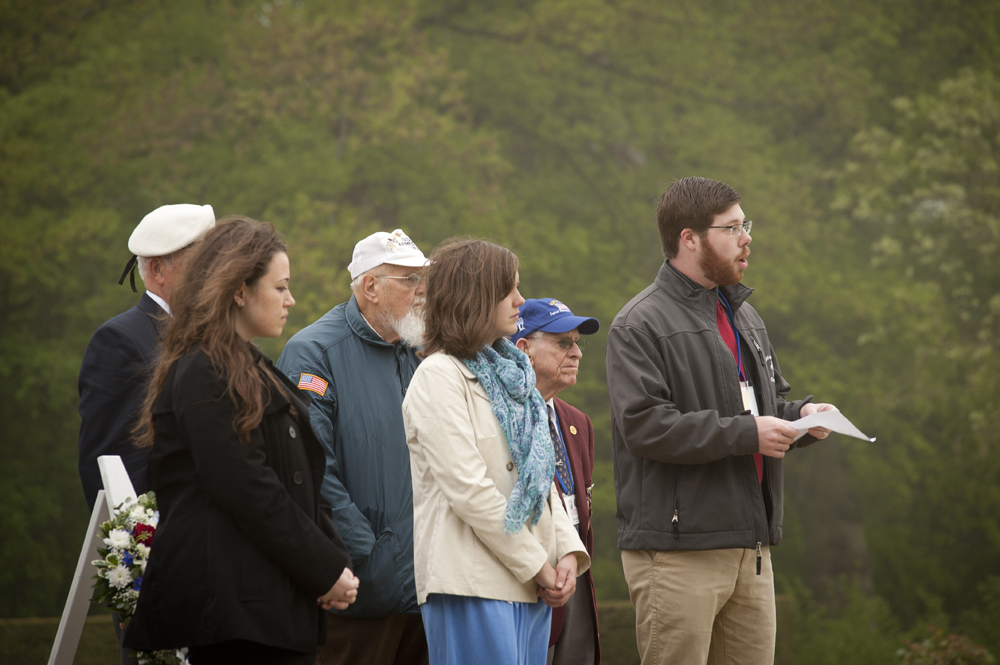
 It seemed like the weather knew that today was going to be different. Overcast skies and chilling temperatures awaited us as we traveled to the Cambridge American Cemetery and Memorial. The gloomy weather adequately reflected the somber tone of the event. Eight Legends (what American Veterans are referred to in the United Kingdom) made their way up to the top of the hill in preparation to raise the American Flag. After hoisting the flag to the top of the pole, the American National Anthem and Taps were played to honor the 8,938 American men and women recognized at the cemetery. A memorial wreath was then presented to commemorate the fallen service men and women. We began to walk down a path containing the Tablets of the Missing. The personal narratives of the young lives, full of potential, that were sacrificed for our country's freedom, were touching.